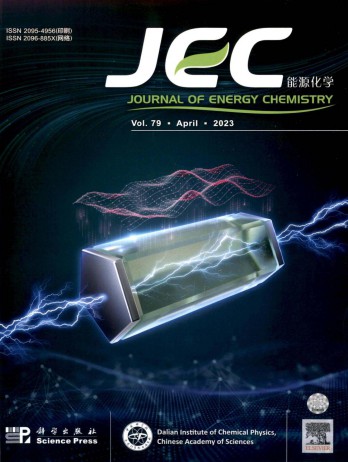
想在《Journal of Energy Chemistry》杂志实现快速发表,需要遵循一定的策略和步骤。
以下是一些建议,具体策略如下:
1. 选择合适的期刊
了解期刊要求:《Journal of Energy Chemistry》杂志要求投稿内容与化学领域相关,确保论文主题符合杂志的定位,主要栏目有研究论文、研究快讯、综述、简讯、会议介绍和国内外著名的从事能源化学研究机构的简介等等。
关注审稿周期:《Journal of Energy Chemistry》杂志的审稿周期预计:预计1-3个月。
2. 提高论文质量
内容质量:确保论文内容新颖、观点明确、数据可靠,避免与已有文献重复。
严格按照《Journal of Energy Chemistry》杂志投稿要求准备稿件:
Preparation of manuscripts (Template)
The manuscripts should be printed on good quality A4 paper in a 12 pt Times New Roman font. All manuscripts should include: a title, list of authors, full addresses of authors, an abstract, keywords, all sections of the body of the manuscript, footnotes, and references.
The title should clearly and accurately indicate the contents of the article or communication and should be expressed in adequate scientific terms. No abbreviations should be used in the title.
The full addresses of authors should be placed below the title.
Footnotes should be included on the first page to give the phone number, fax number, and e-mail address of the author of correspondence, and if applicable, information regarding funding.
We request that authors should submit abstracts for both articles and communications. Abstracts should state briefly the reason for the work, the significant results, and conclusions.
Keywords should be given at the bottom of the abstract to serve as guidelines for indexing.
The body of the manuscript should be subdivided into the following sequence of the sections: Introduction, Experimental, Results and discussion, Conclusions, and References.
Tables and figures must be numbered consecutively with Arabic numerals and should be self-explanatory. Tables must have a brief descriptive title and include footnotes if necessary.“Figure” should be spelled out instead of being written“Fig.” Figures should have figure captions, either with the figures or collected on a separate sheet. The contents of figures, tables, and word descriptions should not be duplicated.Important instructions concerning Figures and Tables are listed as follows:
Each figure should be located at bottom of the paragraph where it is mentioned first in the text.
Size and font of all words including the X and Y axis, units and legends are 7.5 pt and Times New Roman, respectively. The first letter in the first word is capitalized.
Physical quantity is in italic, and the physical quantity and unit is separated by /not by · or blank, such as T/K,Ea/eV,Z/Ω, mL/min, mL/(h?gcat). When English full name of physical quantity is used, unit should be placed in the parenthesis and there is one blank space between them, such as Potential (V),Capacity (mAh/g),Current efficiency (%).
Digit and unit is separated by one blank space. Percentage of weight and volume should be wt% and vol%, not wt.% and vol.%.
Width of figures or images is 8 cm (single column) or 16 cm (double column).
For digital figures, they should be edited in the text. For SEM, TEM, HR-REM images or other photos, their resolution is more than 300dpi
When a figure title contains a few different figures, each figure should be numbered using (a), (b), (c), (d) …… which are inserted in the upper left corner of each figure with closed frame. When a figure contains different lines, these lined should be numbered using (1), (2), (3), (4) …… even though the lines are also differentiated by different colors.
Table must be three-lined format.
Photographs should be of sufficiently high quality with respect to detail and contrast. Indicate the magnification by a bar on the photograph.
References should be numbered consecutively in the order in which they are first mentioned in the text. Abbreviations of journal titles should follow the style used in Chemical Abstracts. Reference accuracy is critical and authors are responsible for the accuracy of the references. Only articles that have been published or are in press should be included in the references. Journal articles and books must be cited by the following formats:
Reference to a journal publication:
[1] J. van der Geer, J.A.J. Hanraads, R.A. Lupton, J. Sci. Commun. 163 (2000) 51–59.
Reference to a book:
[2] W. Strunk Jr., E.B. White, The Elements of Style, third ed., Macmillan, New York, 1979.
Reference to a chapter in an edited book:
[3] G.R. Mettam, L.B. Adams, in: B.S. Jones, R.Z. Smith (Eds.), Introduction to the Electronic Age, E- Publishing, Inc., New York, 1994, pp. 281–304.
All manuscripts should include a graphic abstract. Authors are required to provide a single separate A4 sheet containing a small diagram, or other informative illustration (scheme, formula, figure, etc.) that shows the most important aspect of the paper. The diagram or illustration should be a maximum size of 40 mm high×80 mm wide with color. Style and format of the graphical abstract may be found in the example.
3. 优化投稿流程
网络投稿:通过《Journal of Energy Chemistry》杂志的官方网站进行投稿,确保所有信息填写准确。
快速通道:部分期刊提供快速通道服务,可以缩短审稿和发表周期,但通常需要额外付费。
4. 积极应对审稿意见
及时关注审稿进度、与审稿人沟通、耐心等待录用通知,通过遵循这些建议,作者可以提高论文的发表效率并增加被录用的机会。
《Journal of Energy Chemistry》是由中国科学院大连化学物理研究所;中国科学院成都有机化学研究所主办的期刊。
《Journal of Energy Chemistry》获奖情况:四川省质量一级期刊
《Journal of Energy Chemistry》在报道世界范围内天然气化学及其相关领域的最新发展动态和科技信息,增进国际交流,促进科技发展。以天然气及其相关领域从事化学和化学工程方面研究的科研人员及工程技术人员、大专院校的本科生、研究生和教师等为读者对象。
《Journal of Energy Chemistry》主要报道化石能源优化利用、氢能的研究与利用、电化学能转化与储存、二氧化碳捕获、储存与化学利用、能源利用中的材料和纳米技术、生物质转化和光催化中相关的化学问题。
综上所述,《Journal of Energy Chemistry》杂志是一本具有较高学术水平和影响力的化学类期刊,它为广大化学工作者提供了一个展示研究成果、交流化学思想的平台。
《Journal of Energy Chemistry》杂志往年文章平均引文率
 投稿咨询
投稿咨询声明:本信息依据互联网公开资料整理,若存在错误,请及时联系我们及时更正。