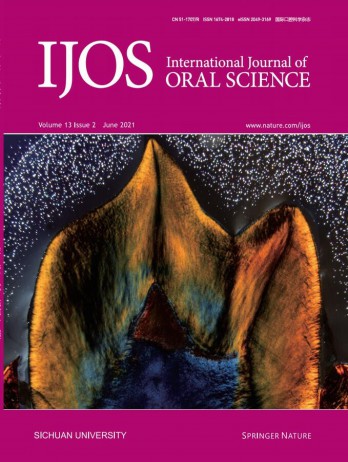
《International Journal of Oral Science》杂志论文格式要求:
Abstract
A concise and factual abstract is required. The abstract of original article should state briefly the purpose of the research, the principal results and major conclusions with such headings in a structured format. An abstract is often presented separately from the article, so it must be able to stand alone. For this reason, References should be avoided, but if essential, then cite the author(s) and year(s). Also, non-standard or uncommon abbreviations should be avoided, but if essential they must be defined at their first mention in the abstract itself. The length should be less than 250 words for review and original research, less than 100 words for case report. Abstract is not required for letter.
Keywords
Immediately after the abstract, provide a maximum of 5, but at least 3, keywords , using American spelling and avoiding general and plural terms and multiple concepts (avoid, for example, "and", "of"). Be sparing with abbreviations: only abbreviations firmly established in the field may be eligible. These keywords will be used for indexing purposes.
Abbreviations
Define abbreviations that are not standard in this field in a footnote to be placed on the first page of the article. Such abbreviations that are unavoidable in the abstract must be defined at their first mention there, as well as in the footnote. Ensure consistency of abbreviations throughout the article.
Acknowledgements
Collate acknowledgements in a separate section at the end of the article before the references and do not, therefore, include them on the title page, as a footnote to the title or otherwise. List here those individuals who provided help during the research (e.g., providing language help, writing assistance or proof reading the article, etc.).
Conflict of interst
All authors must disclose any financial and personal relationships with other people or organizations that could inappropriately influence (bias) their work at the end of the article before the references. If there are no conflicts of interest then please state this: 'Conflicts of interest: none'.
Nomenclature and units
Follow internationally accepted rules and conventions: use the international system of units (SI). If other quantities are mentioned, give their equivalent in SI. You are urged to consult IUB: Biochemical Nomenclature and Related Documents.
Footnotes
Footnotes should be used sparingly. Number them consecutively throughout the article. Many word processors can build footnotes into the text, and this feature may be used. Otherwise, please indicate the position of footnotes in the text and list the footnotes themselves separately at the end of the article. Do not include footnotes in the Reference list.
基本信息
《International Journal of Oral Science》杂志是由中华人民共和国教育部主管,四川大学主办的国内外公开发行的学术理论期刊,创刊于2009年,是国内医学领域具有广泛影响力的权威刊物。
该杂志国内刊号为51-1707/R,国际刊号为1674-2818,现被CSCD 中国科学引文数据库来源期刊(含扩展版)、统计源期刊(中国科技论文优秀期刊)、知网收录(中)、维普收录(中)、万方收录(中)、CA 化学文摘(美)、SCI 科学引文索引(美)、哥白尼索引(波兰)、剑桥科学文摘、国家图书馆馆藏、上海图书馆馆藏、文摘与引文数据库等权威数据库收录。
此外,还荣获多项荣誉,如:中国优秀期刊遴选数据库、中国期刊全文数据库(CJFD)、中国科技期刊优秀期刊等,这些都体现了该杂志在推动医学理论与实践发展方面的重要贡献。
栏目设置
《International Journal of Oral Science》杂志栏目涵盖医学领域多个维度,包括:原创科学论文、综述、临床研究、病例报告、会议报道、致编辑信等。
作为一本具有较高学术水平和影响力的医学杂志,多年来一直致力于推动医学领域的改革与发展,为医学工作者和研究者提供了一个交流和探索的平台,对促进我国医学事业的发展起到了积极的作用。
 投稿咨询
投稿咨询声明:本信息依据互联网公开资料整理,若存在错误,请及时联系我们及时更正。